

The AI Is Guessing. Confidently. Fluently. And Completely Wrong for Your Business.
“I’m not guessing with AI anymore. I design it.”
— The shift every Context Stack™ user makes in their first 60 minutes.
Built by someone who designs AI systems at the highest level
Google · iHeart Media · Home Depot · New York Life · Wayfair · Lenovo · HelloFresh · MorningStar · Nationwide
A Day in Your Life (Right Now)
You open ChatGPT. You type “write me an email for our spring promo.” You get back three paragraphs of generic, cheerful fluff. The CTA is vague. The tone is off. You manually rewrite 80% of it and still aren’t sure it’s right.
You do this five, six, seven times a day — for emails, campaign briefs, social posts, landing page copy. Every interaction follows the same pattern: type something vague, get something mediocre, spend 30 minutes fixing it.
You know AI should be saving you time, but most days it feels like extra work with a polished veneer.
Type something vague → get something mediocre → spend 30 minutes fixing it.
You’re not using AI. You’re babysitting it.
Let’s Do the Math You’ve Been Avoiding
Five to seven rewrites a day. Thirty minutes each. That’s 2.5 to 3.5 hours every day spent editing output that should have been right the first time.
That’s 12–17 hours a week. 60+ hours a month. More than a full work week — every month — lost to fixing what AI got wrong.
What would you do with 60 extra hours? Build the campaign you’ve been putting off? Leave work on time? Actually think strategically instead of drowning in execution?
Those hours aren’t coming back. And every day you prompt AI without organized context, you’re losing more of them.
Here’s What’s Actually Happening
You’re carrying critical business context in your head — your audience, your positioning, your constraints, your capacity, what “good” actually means for your organization — and you’re never giving any of it to the AI.
Or you’re dumping it in a wall of text the model can’t parse.
Either way, the LLM is guessing. And it guesses confidently. Fluently. And completely wrong for your situation.
Every mediocre output. Every generic email. Every campaign brief you have to rewrite. It’s not because the model is broken. It’s not because you need better prompts.
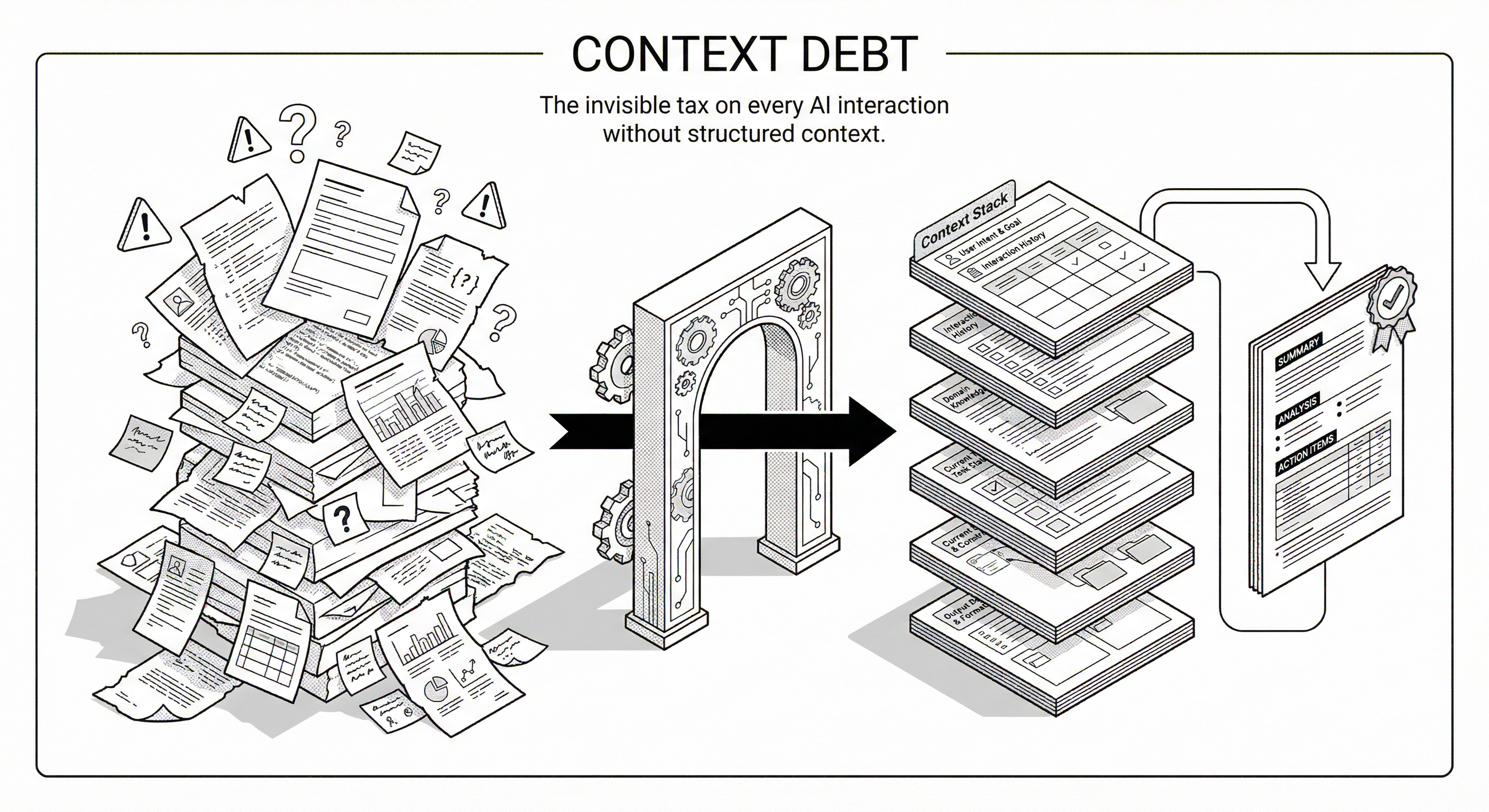
It’s because you’re paying Context Debt.
Context Debt is the invisible tax on every AI interaction where you make the model guess instead of giving it organized context. And right now, you’re paying it on every single prompt. Five, six, seven times a day. Week after week.
The time you thought AI was saving you? Context Debt is eating it alive. And the longer you wait, the more it compounds.

And the Industry Isn’t Helping
Meanwhile, the “AI productivity” industry keeps telling you the fix is better prompts. Prompt packs. Prompt hacks. Prompt libraries with fifty copy-paste shortcuts that work once and fail the moment your situation changes.
None of them touch Context Debt. They’re rearranging words while the real problem compounds.
If nothing changes, six months from now you’ll still be rewriting every AI output, still wondering why it feels like extra work with a polished veneer. The question isn’t whether you can afford $37. It’s whether you can afford to keep losing 60+ hours a month to a problem with a 60-minute fix.
But Here’s What the Top 1% of AI Users Already Know
There are two types of marketing managers using AI right now:
Type 1
Types something into ChatGPT, gets back generic fluff, rewrites most of it, and assumes that’s the deal. They think they’re “using AI.” They’re actually babysitting it.
Type 2
Pastes in organized context before every interaction — role, objective, constraints, output structure, guardrails — and gets back structured, specific, ship-ready output on the first pass. No rewriting. No gambling.
The difference isn’t talent. It’s not technical skill. It’s not even which AI model they use.
The difference is context. Organized, structured context that the LLM can actually understand.
Right now, almost nobody is organizing context this way. But here’s the real cost of waiting: Context Debt compounds. Every day you prompt AI without organized context is another 2–3 hours spent rewriting output that should have been right the first time. That’s 10–15 hours a week. 60+ hours a month.
The operators who fix this now get those hours back. The ones who don’t keep paying.
How I Discovered the One Thing That Actually Fixes AI Output
I’ve spent years designing production-grade AI systems for Google, iHeart Media, Home Depot, Wayfair, New York Life, and Nationwide. Not learning AI on the side — architecting it at the highest level.
And I kept watching the same pattern: smart operators typing reasonable prompts, getting back generic fluff, and spending thirty minutes rewriting it. They all thought that was normal. It’s not.
The problem was never the prompt. It was the missing context. These operators were carrying critical business reality in their heads — audience, positioning, constraints, standards — and never giving any of it to the AI in a format it could parse.
So I tried something simple: instead of rewriting prompts, I started organizing context — six labeled layers, each giving the LLM a specific type of information. The output changed immediately. Not a little. Fundamentally. Predictable, structured, and usable on the first pass.
I built a repeatable architecture around that insight. Six layers. One system. Sixty minutes. That’s the Context Stack™.
Next Monday Morning
It’s 8:47 AM. You open ChatGPT. But instead of typing something vague and hoping for the best, you paste in your Context Stack — the one you built last week, with your company’s positioning, your audience, your constraints, and your brand standards already organized.
You type: “Write me a campaign brief for our Q3 product launch.”
Twelve minutes later, you’re reading a structured brief with specific audience targeting, messaging pillars tied to your Q1 case study, a 6-week timeline with milestones, and risk flags for budget allocation. The CTA drives to your booking form. The tone matches your brand. You make two small edits and send it to your boss.
Your boss replies: “This is sharp. How did you turn this around so fast?”
You smile. You don’t explain it yet. You just know that the 30-minute rewrite cycle is over — permanently.
By 9:15 AM, you’ve shipped something that used to take until lunch. And you’ve got the rest of the morning to actually think strategically instead of editing AI output.
That’s what organized context does. Not once. Every time.

Before I Show You the Full System — Take 10 Seconds
Imagine opening ChatGPT tomorrow and getting back a campaign brief you can actually ship. The objective is specific to your business. The constraints are respected. The CTA is clear. The tone matches your brand. And you did it in 12 minutes instead of 60.
Not because you found a magic prompt. Because you gave the AI organized context — and it finally had what it needed to do its job.
That’s what happens after the Context Stack™.
Context Stack™ — Marketing Edition
This isn’t a course. There are no videos to watch, no modules to “complete.”
This isn’t a prompt pack. Copy-paste prompts without context produce the same mediocre output.
This isn’t AI hype. No “10x your productivity” promises.
This is a structured system that installs one new professional standard: You don’t hit enter without organized context.
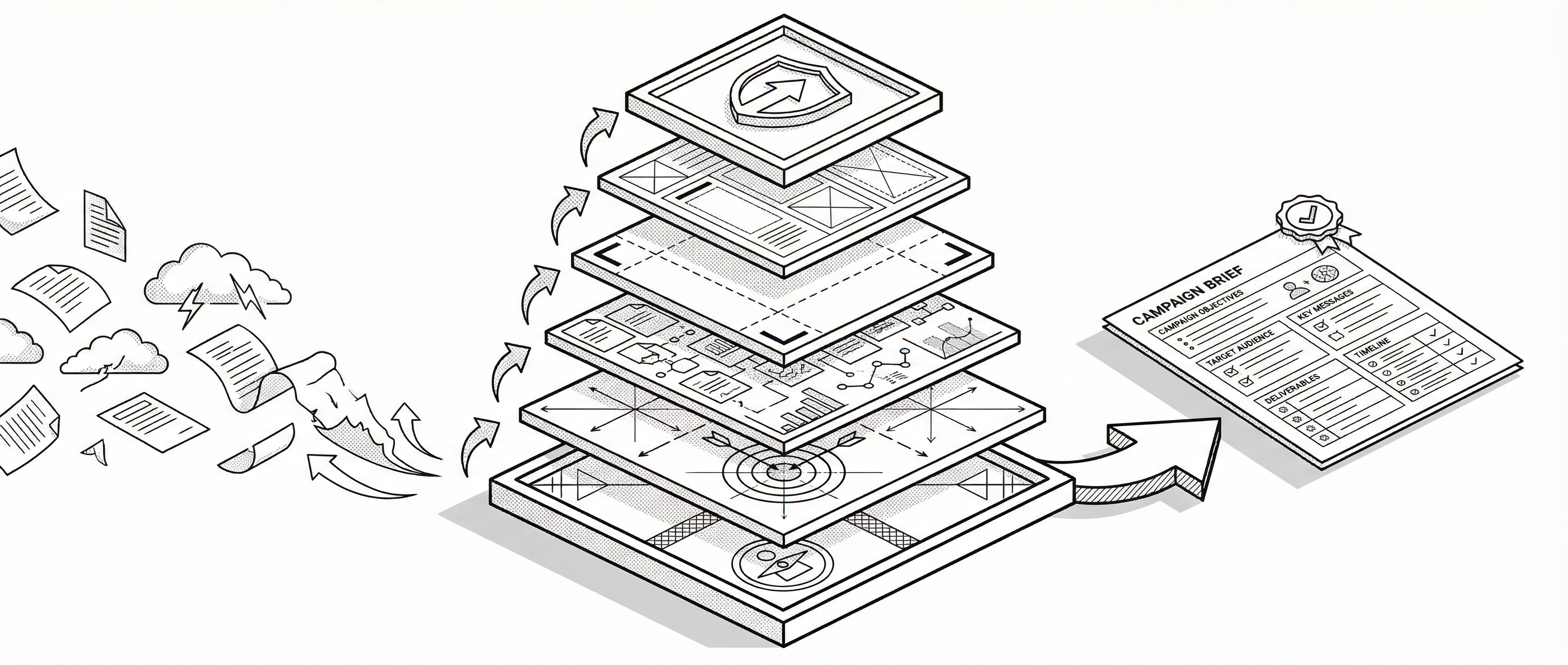
The Context Stack™ is a repeatable 6-layer context architecture that converts the business reality in your head into a structured format the LLM can actually understand — so output stops drifting and starts behaving like a disciplined operator.
Delivered as an interactive Notion system you duplicate into your workspace and own forever. You build it. You fill it with your business context. It becomes yours — not a template you borrowed, but an operating system you created for your specific business. (PDF backup included.)
How It Works: The 6 Pillars
Each pillar builds on the last. Each one takes 10–15 minutes. The full system takes 60 minutes.
| Pillar | What It Installs | Key Tool |
|---|---|---|
| 1. The Average Output Problem | Awareness that vague prompts create vague output — and exactly where yours are leaking value | Context Stack™ Master Template™ |
| 2. The Context Stack™ | The 6-layer context architecture: Role, Objective, Business Context, Constraints, Output Structure, Risk Guardrails | Campaign Architect Prompt Framework |
| 3. Structured Objectives | Measurable campaign goals — metric + target + timeframe — that anchor every output | Structured Objective Template |
| 4. Output Structure Enforcer Template | Section-based templates that kill paragraph soup and force organized, actionable output | Output Structure Enforcer Template |
| 5. Reliability Scan Checklist | Validation that catches the dangerous 30% — risky claims, wrong numbers, tone shifts — before you ship | Reliability Scan Checklist + QA Scorecard |
| 6. The 60-Minute Proof | A complete, ship-ready Campaign Strategy Brief generated using the full Context Stack™ | Sprint Framework |
By the end of Pillar 6, you’ll have a Campaign Strategy Brief that is visibly sharper than anything you’ve produced with AI before.
Not because the model got better. Because you finally gave it organized context.
How to Evaluate Any AI Productivity System (Before You Buy Anything)
Before you spend money on any AI tool, template, or system, ask three questions:
| Question | Prompt Pack | AI Course | Context Stack™ |
|---|---|---|---|
| Works for ANY situation? | No — breaks when your context changes | Maybe — you have to adapt the theory yourself | Yes — the architecture adapts to every prompt, every tool, every situation |
| How fast to a real result? | Immediate — but generic | Weeks — finish the course first | 60 minutes — ship-ready Campaign Strategy Brief |
| System or shortcut? | Shortcut — works once, collects dust | Knowledge — but no reusable tools | System — build once, use every day, gets better |
The Context Stack™ wins on all three. That’s not marketing — it’s architecture.
Why This Works (The Technical Truth)
LLMs are pattern-completion machines. They generate output based on the inputs they receive. When your input is “write me a campaign brief,” the model has to guess your audience, your constraints, your tone, your goals, and your definition of “good.” That’s a massive search space — and the model fills it with safe, generic defaults.
When you add organized context — labeled, structured, and specific — you collapse that search space. The model stops guessing and starts matching. Same AI. Dramatically different output.
This isn’t a theory. It’s how the technology works. The Context Stack™ just makes it systematic.
The Difference Is Immediate
❌ Without the Context Stack™
Prompt: “Write me a campaign brief for our spring promo.”
Output: A 3-paragraph overview mentioning “engaging content” and “target audience” with a vague CTA like “Drive conversions through multi-channel outreach.” Could be for any company. You rewrite 80%.
✅ With the Context Stack™
Prompt: [Context Stack — Role: strategist for B2B landscaping co. Objective: 40 leads in 6 weeks. Constraints: $3K budget, no paid social.]
Output: Structured brief — audience (commercial property managers, Northeast), channels (email + LinkedIn + direct mail), messaging tied to Q1 case study, 6-week timeline, risk flags, CTA to estimate form. Minor edits. Ship it.
Same AI. Same request. Completely different output.
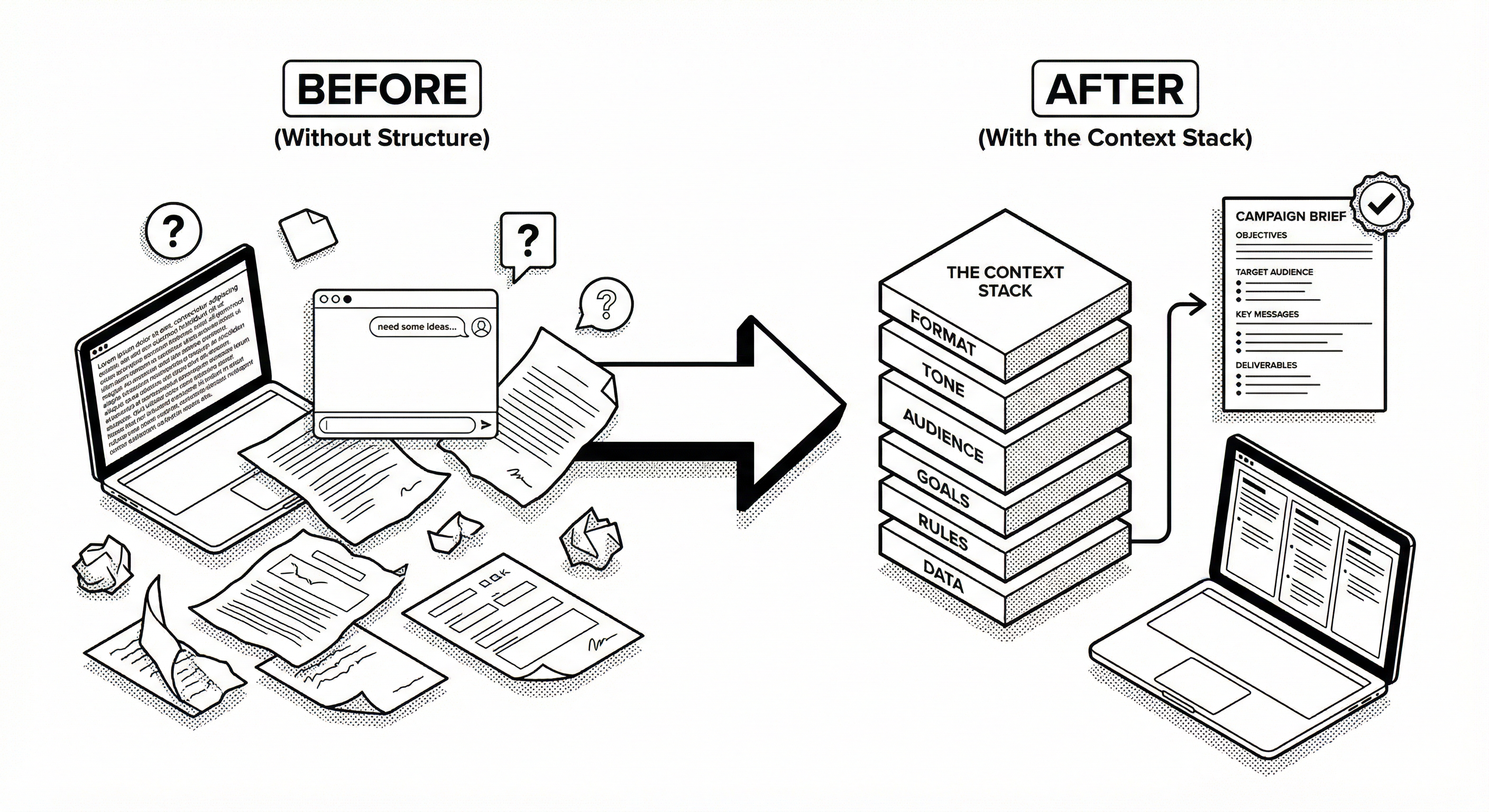
The only difference: organized context.
What You Can Expect
- First 15 minutes: Run the Context Stack™ Master Template™ on a real prompt and see exactly where your Context Debt is hiding
- First 30 minutes: Build your Campaign Architect Prompt Framework — a reusable business context packet you’ll paste into every AI interaction
- First 60 minutes: Generate a complete Campaign Strategy Brief using the full system — and feel the difference on the first pass
- Every day after: Paste your Context Stack before every serious AI interaction. Output quality stays locked in.
Wait — Let Me Be Direct for a Second
If you’ve read this far, you’re not someone who buys things on impulse. You’re doing your research. You’re evaluating. Good — that’s exactly the kind of operator this system was built for.
When was the last time a $37 investment had the potential to save you 60+ hours a month? Not in theory. In practice. Starting this week.

Here’s EVERYTHING You Get Today
🎯 Core System
The Context Stack™ — Marketing Edition ($197 Value)
The complete 6-pillar system: from audit to architecture to ship-ready output in 60 minutes. Delivered as an interactive Notion system you duplicate and own forever.
💰 Context Stack™ Master Template™ Checklist ($47 Value)
The 3-minute diagnostic that reveals exactly where your prompts are leaking value. Works on any AI tool.
💰 Campaign Architect Prompt Framework ($97 Value)
The 6-layer context architecture you fill out once and paste into every AI interaction. The core asset that eliminates Context Debt.
💰 Output Structure Enforcer Template ($97 Value)
Campaign briefs, marketing emails, SOPs, landing pages, social posts — pre-built formats that kill paragraph soup.
💰 Reliability Scan Checklist + QA Scorecard ($67 Value)
The pre-ship validation system that catches the dangerous 30% before you publish.
💰 60-Minute Install Plan ($27 Value)
Visual completion tracking built into the Notion system — never lose your place.
⚡ BONUS STACK — Included With Your Order Today
⚡ ‘Lazy vs. Architected’ Prompt Comparison Library ($67 Value)
Get a real, tangible win in 15 minutes flat — before you even start the full system. Three steps. One deliverable. Done.
⚡ Brand Context Builder Worksheet ($37 Value)
Your entire system on one page. Print it. Pin it. Never forget a layer.
⚡ One-Page Context Stack™ Cheat Sheet ($27 Value)
The full system as a clean, formatted PDF — works with or without Notion.
Total Value: $683. Today: $37.
| Context Stack™ 6-Pillar System | $197 |
| Context Stack™ Master Template™ Checklist | $47 |
| Campaign Architect Prompt Framework | $97 |
| Output Structure Enforcer Template | $97 |
| Reliability Scan Checklist + QA Scorecard | $67 |
| 60-Minute Install Plan | $27 |
| ⚡ ‘Lazy vs. Architected’ Prompt Comparison Library | $67 |
| ⚡ Brand Context Builder Worksheet | $37 |
| ⚡ One-Page Context Stack™ Cheat Sheet | $27 |
| TOTAL VALUE | $683 |
$683
Today: $37
That’s $1.23 per day for the first month — less than the coffee you bought this morning. Except the coffee is gone by noon. This system works every day for the rest of your career.
One-time payment. No subscription. Instant access.
🛡️
The “Ship-Ready Output” Guarantee
Here’s exactly how this works:
- Get instant access
- Duplicate the Notion system into your workspace — it’s yours to keep, forever
- Work through the 6 pillars (60 minutes)
- Run the 60-Minute Proof in Pillar 6
- Generate your Campaign Strategy Brief using the full Context Stack™
If the output isn’t visibly sharper than your normal AI work — if you don’t feel the difference on the first pass — send one email to support@promptsquad.ai with the subject line “Not sharper” and I’ll refund every penny.
No questions asked. No hard feelings. No hoops.
You keep the system. You keep the templates. You keep the Quickstart Guide. You keep the PDF backup. You keep everything.
Why? Because once you’ve built your Context Stack, it becomes yours — your business context, your constraints, your output structure. It’s not my system anymore. It’s your operating standard. And I don’t want it back.
I’m taking all the risk because I’ve seen what happens when someone adds organized context for the first time. The output speaks for itself.
In three years of building this system at enterprise scale, not one person who completed the 60-Minute Proof has said the output wasn’t sharper. Not one.
You Have Two Options Right Now
Path 1
Close this page. Go back to ChatGPT tomorrow. Type something reasonable. Get back generic fluff. Rewrite 80% of it. Spend thirty minutes fixing what should have taken five. Do it again the next day. And the next. Six months from now, you’ll still be babysitting AI and wondering why it was supposed to save you time.
Path 2
Invest $37 today. Duplicate the system into your Notion workspace. Run the 60-Minute Proof. Generate a Campaign Strategy Brief that’s sharper than anything you’ve produced with AI before. And from that point forward, paste your Context Stack into every AI interaction and get output you can ship — on the first pass.
Same AI. Same you. Different context. Different output.
Here’s What to Do Next
- Click the button below
- Complete your secure checkout ($37 — one-time, no subscription)
- Get instant access — duplicate the Notion system into your workspace
- Start with the ‘Lazy vs. Architected’ Prompt Comparison Library or dive into Pillar 1
In 15 minutes, you’ll have your first win. In 60 minutes, you’ll have a ship-ready Campaign Strategy Brief. By this time tomorrow, you’ll wonder why you ever prompted AI without organized context.
Frequently Asked Questions
Who is this for?
Anyone who uses AI regularly for real work — marketers, founders, operators, strategists, consultants, freelancers — and is tired of rewriting everything it gives back. If you’re smart, busy, and feel like AI should be sharper than what you’re getting, this is built for you.
Is this a course?
No. There are no videos, no modules, no “lessons.” This is a system — you duplicate it into your Notion workspace (or download the PDF), work through the 6 pillars, and build reusable assets you’ll use every day. Think of it as installing a new operating system for how you use AI.
How long does it take?
The full system takes about 60 minutes. If you’re short on time, the ‘Lazy vs. Architected’ Prompt Comparison Library gives you a real win in a quarter of that. Either way, you’ll feel the difference on your very first output.
Do I need to use Notion?
The primary experience is built in Notion — it’s interactive, includes templates and checklists, and feels like a professional system. But a complete PDF backup is included if you don’t use Notion. The system works either way.
Will this work with Claude / Gemini / Copilot?
Yes. The Context Stack™ is AI-tool agnostic. It’s a context architecture, not a prompt pack. You paste it into whatever tool you use. The organized context improves output in any LLM.
I’ve tried prompt packs before. How is this different?
Prompt packs give you words to copy. The Context Stack gives you a structure that makes every prompt work better — because the problem was never the words. It was the missing context. This addresses the root cause. Prompt packs treat symptoms.
I already give ChatGPT context. How is this different?
Most people who “add context” include a sentence or two of background, or dump a long paragraph the model can’t parse cleanly. Neither is organized context. The Context Stack structures it into 6 labeled layers — each giving the LLM a specific type of information in a format it can use. The difference between “I mentioned my audience” and a full parsed input with role, objective, constraints, output format, and guardrails is the difference between output you rewrite and output you ship.
Is this just a Notion template?
It lives in Notion — but it’s not a template. It’s a working system with 10 reusable tools, 6 progressive pillars, and a 60-minute sprint that produces a real Campaign Strategy Brief. A blank spreadsheet is a template. A spreadsheet with formulas, validation, dashboards, and a built-in process is a system. This is the second one.
What if I’m not technical?
This was built for operators, not engineers. If you can fill out a form with six fields, you can use the Context Stack. The system guides you through every step.
What’s your refund policy?
Run the 60-Minute Proof. If the output isn’t visibly sharper than your normal AI work, email support@promptsquad.ai with the subject line “Not sharper” and I’ll refund every penny. You keep the system.
Still here? Good. Let’s settle this.
You use AI every day — yes?
You know the output should be better than what you’re getting — yes?
You’ve tried better prompts, different wording, maybe even a prompt pack — and the output is still generic, still needs heavy editing — yes?
And if someone showed you the actual root cause — the one variable that makes AI output reliable every single time — you’d want to fix it — yes?
That’s exactly what the Context Stack™ does.
You’re not buying a course. You’re not buying prompts. You’re installing a system — one you’ll build with your own business context, own forever, and use on every AI interaction from this point forward.
- ✅ Protected. The Ship-Ready Output Guarantee means if it doesn’t work, you get every penny back — and you keep the system
- ✅ $683 in tools for $37. That’s 94% off — less than $1.23 per day for the first month
- ✅ Immediate difference. The ‘Lazy vs. Architected’ Prompt Comparison Library alone will change your very next AI output
- ✅ Yours forever. No subscription. No expiration. No login. It’s yours.
One system. Sixty minutes. Ship-ready output on the first pass.
The only question left: do you want to keep paying Context Debt — 2.5 to 3.5 hours a day, 60+ hours a month, rewriting output that should have been right the first time — or do you want to fix it in 60 minutes for $37?
P.S. Every prompt you run without organized context is Context Debt you’re paying in wasted time. The average marketing manager rewrites AI output 5–7 times a day, 30 minutes each. That’s 2.5–3.5 hours a day. 60+ hours a month. More than a full work week — every month — spent fixing what should have been right the first time. The Context Stack™ costs $37 and takes 60 minutes to install. The math isn’t even close.
P.P.S. Remember — you’re not bad at AI. You’re paying Context Debt. And it takes sixty minutes to stop. Imagine what you’d do with 60 extra hours next month.